Handshake
Reimagining the Handshake Profile for Gen Z Storytelling
Role
Design Consultant
Synthesis Lead
Team
Aashna Patel
Grace Zhang
Madison Lee
Ashley Canizalez
Piper Yu
Contributions
UX Research • Competitive Analysis • User Personas • Prototyping • Product Strategy
Tools
Figma • Figjam • Qualtrics
Timeline
February — June 2025

CONTEXT
Rethinking what a “professional profile” means for Gen Z
Handshake is the leading early-career platform, connecting 20M+ students and alumni to 1M+ employers. At Berkeley Innovation, my team reimagined the traditional student profile, transforming it into a portfolio-friendly experience that Gen Z would be excited to share with employers and peers. We explored how students across majors and universities showcase their work, translate projects into professional stories, and engage with different portfolio formats. Our research informed design concepts, including the Milestones feature, which was presented to 14 PMs and designers.
USER PROBLEM
Profiles show outcomes, but hide how students actually work
Current profiles reduce student work to polished bullet points, obscuring the process, iteration, and collaboration behind projects. This makes it difficult, especially for underclassmen and interdisciplinary students, to tell a cohesive story, understand what recruiters value, or stay motivated to update their profiles.

01 Understand how students across majors showcase their work today
02 Investigate what “portfolio” means to students at different stages
03 Identify which artifacts (process, reflection, collaboration, media) matter
04 Learn what motivates or discourages students from engaging with profiles
COMPETITIVE ANALYSIS
Learning from Other Platforms
We audited 12 platforms students use to present themselves professionally, including career platforms (LinkedIn, Indeed), portfolio builders (Notion, Webflow), and creative/technical spaces (Behance, GitHub)

Strengths from Other Platforms:
Provide guidance through prompts and templates
Create engagement loops through comments and visibility signals
Offer high customization and flexibility
Support rich media and embeds (visuals, video, code, links)
Limitations with Handshake
Lack interactivity
Favor text-only input
Lack support for evolution, iteration, or growth over time
Enforce fixed layouts non-linear and interdisciplinary narratives
USER RESEARCH
Understanding how students want to showcase their work and why it’s hard today
User Survey

Surveyed 80 undergraduates across majors and institutions to uncover patterns in profile usage, showcasing preferences, and layout limitations.
User Interviews

Conducted 30 interviews across 20 majors to learn how students translate projects, process, nontraditional work into professional narratives
Usability Tests


Observed 20 students reviewing their Handshake profiles to identify breakdowns in storytelling, motivation, and visibility of growth.
KEY INSIGHTS
Reframing the problem from “content” to “storytelling”
Through affinity mapping, journey mapping, and theme prioritization, we reframed the challenge: students need structured support to tell a meaningful story about how they work.

Profiles feel passive and invisible
Lack of feedback or recruiter visibility makes profiles feel static, reducing incentives to update or personalize
Process is as important as outcomes, but hard to show
While 80% of students value sharing their process, but only 18.3% feel current profiles let them fully tell their story.

Rigid layouts flatten diverse paths
45.5% of students feel constrained by standardized, text-heavy layouts, specially early-stage, creative, and interdisciplinary students.

Lack of guidance increases effort and uncertainty
Without clear examples, peer benchmarks, or evaluation signals, profile updates feel high-effort and low-confidence.

REVISED HMW
How might we design a platform that enables students to dynamically showcase their unique processes within their projects, rather than reducing them to bullet points?
USER PERSONAS
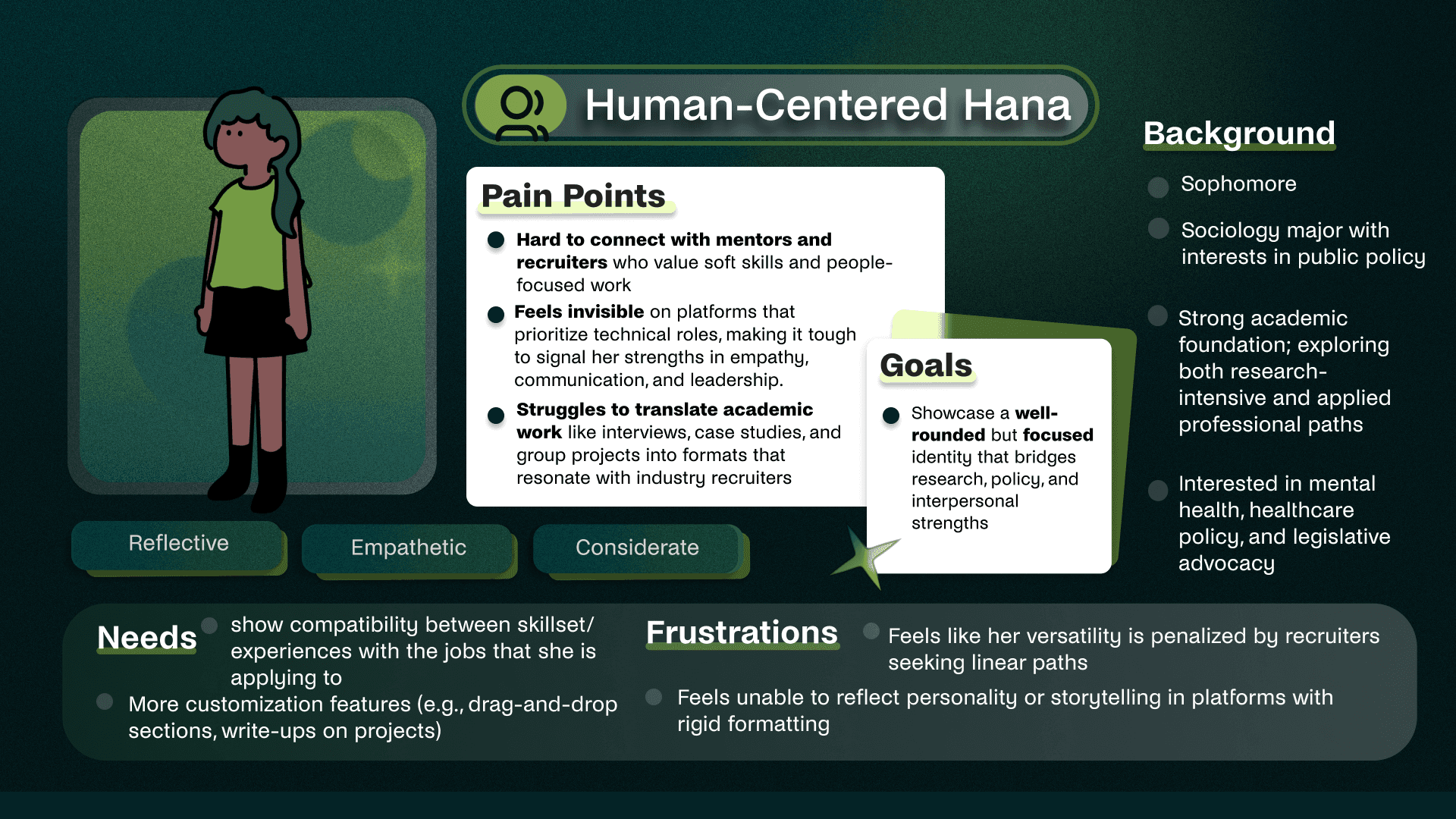
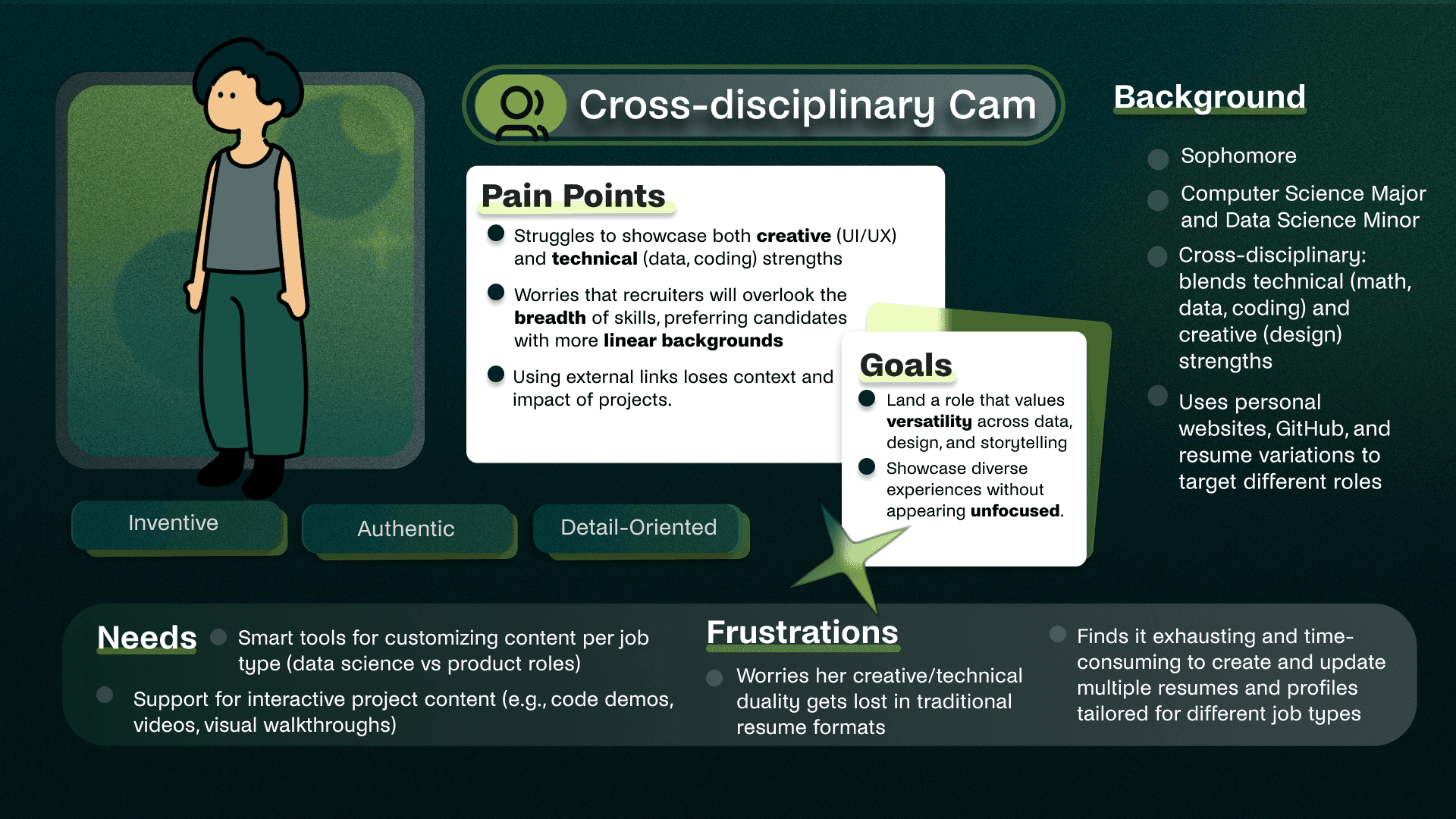
Designing for students at different stages of confidence and clarity
We developed multiple personas to reflect diverse motivations and anxieties.




IDEATION
Exploring broadly, then converging with intention
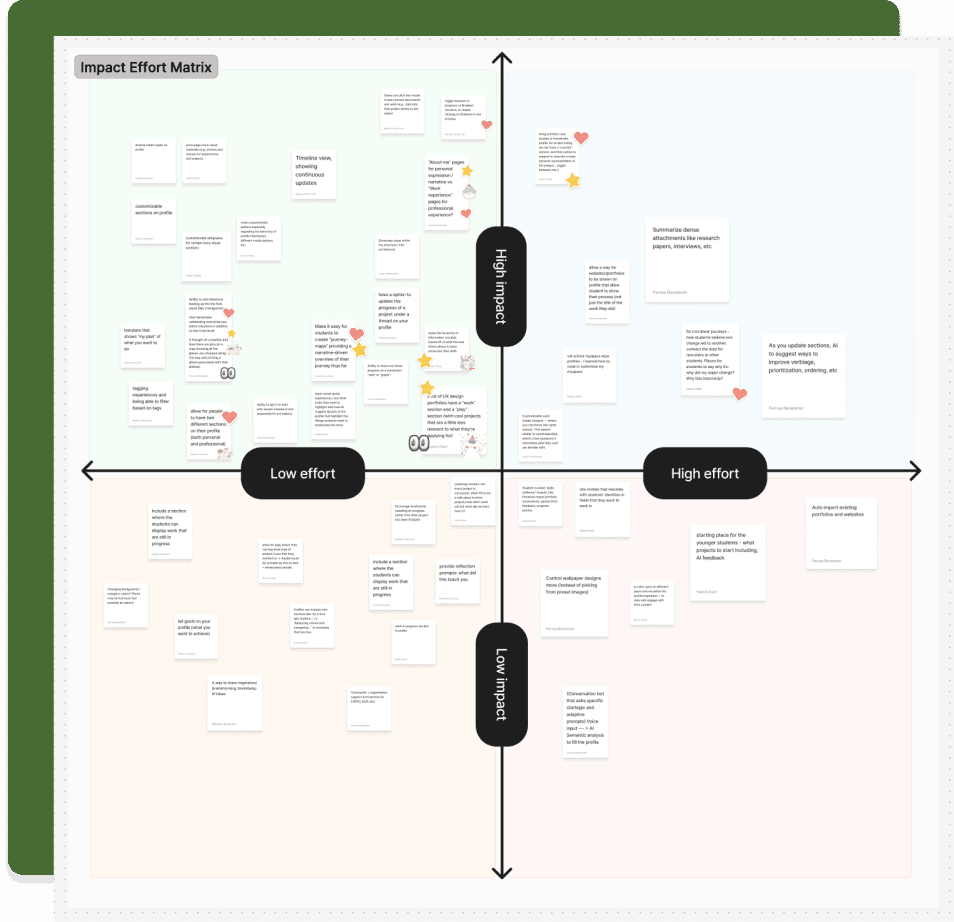
We used rapid ideation methods, including Crazy 8s, to explore a wide range of concepts centered on storytelling, customization, and process visibility. Ideas were then evaluated using an impact–effort matrix, prioritizing solutions that delivered high user value while fitting within Handshake’s existing profile structure.


WIREFRAMES
Initial Profile Feature Explorations
Given the limitations of static, resume-driven profiles and students’ desire to showcase process, growth, and individuality, we explored low-fidelity concepts that would help students tell richer project stories, experiment with different ways of presenting their work, and understand how their profiles might be perceived by recruiters.
FINAL CONCEPT
Milestone-Based Project Breakdowns
Milestones allow students to break projects into meaningful phases—highlighting learning, iteration, and collaboration alongside outcomes.
Key Features
Timeline-style project breakdowns
Each milestone includes optional media and reflection
Emphasizes progress over polish
Maintains scannability for recruiters
Why milestones?
They encourage reflection, legitimize in-progress work, and help students communicate value even without finalized results.
Rich Media Project Embeds
Enable students to integrate visuals, video, audio, and interactive content directly within project sections, so work can be experienced in context rather than redirected with external links.
Modular Profile Structure
Enable flexible hierarchy through movable or modular sections so students can emphasize what matters most, while maintaining a clear and consistent profile framework.
LEARNINGS AND IMPACT
Motivation is shaped by visibility and feedback loops
Seeing how static profiles discouraged updates revealed that engagement isn’t just a UX issue but a behavioral one — students are more willing to invest in their profiles when they feel their work is seen, contextualized, and understood by recruiters and peers.
Research depth directly strengthened design direction
Synthesizing interviews, surveys, and platform audits helped us reframe the problem from “make profiles more customizable” to “help students confidently translate their work into professional stories,” resulting in a concept that balanced rich media, reflection, and recruiter scannability within Handshake’s existing constraints