The future of work is being shaped by automation, AI, and digital collaboration tools that prioritize speed and efficiency while often neglecting the human experience of work, leaving many people disconnected from meaning, agency, and one another.
Context
Current tools answer the question “How do we do work faster?” but rarely ask “How should work feel and function for humans in the future?”
Problem
Design a hybrid physical–digital system that makes work more humane, ethical, and meaningful — not just more efficient.
Challenge
Project Motivation


Cognitive energy awareness for your sustainable work performance
Team: Elisa Lupin-Jimenez, Madison Lee, Douglas McGowan, Apolline Tardy
The increasing need for rapid responsiveness and adaptation in the AI-driven hybrid workplace leads to anxiety and burnout among knowledge workers. This creates an opportunity to improve workers' agency in balancing high-focus work and high-connection communication.
Product Opportunity Gap
User Research
User Interviews
To explore this, we conducted five semi-structured interviews with professionals across design, engineering, marketing, and healthcare technology transcribed with Zoom AI transcription. Interview topics included communication norms, AI tool usage, interruption management, burnout, attention fragmentation, and strategies for deep work.
Synthesis
Insights and Design Implications
More is Just More
Users already have complex workflows; additional tools often create friction.
Implication: Integrate into existing workflows, don’t add new management layers.
Workarounds are Still Common
Even advanced users rely on simple, self-made solutions.
Implication: Designs must outperform existing workarounds.
Environments Chosen for Short-Term Needs
Hybrid workers choose locations based on task needs.
Implication: Design for different contexts: deep work vs. collaboration.

Product Requirements
Novelty: Not another app, chatbot or screen
Low effort: Minimal digital interaction for the user
Trustworthy: Makes the user feel less surveilled
Hybrid-ready: Connects in-office and remote workers
Tangible: Input & output happen through presence, gesture, or simple touch
Divergence and Exploration
We ideated over 40 ideas spanning ambient environmental displays, personal desk objects and wearables, spatial and architectural interventions, social and connection-centered concepts.


Affinity Clustering of the Team’s Concepts
Storyboarding
Convergence and Decision
We converged on our final three concepts:


Psych Battery
A physical battery that represents mental energy, depleting with digital work and recharging through offline activities like breaks or social interaction.
Dual Dial
A dual-ring device that signals focus state and controls the level of AI assistance from manual to automated
Living Office Map
A real-time physical office map showing presence and focus states, allowing subtle signals to initiate connection or meeting
We rapid-prototyped two concepts:
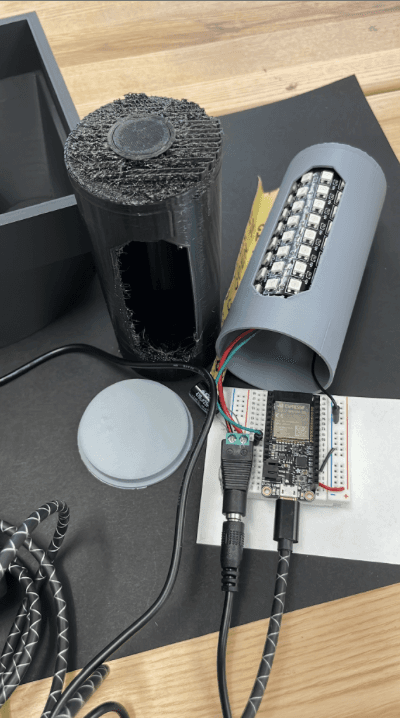
Psych Battery Device:
A standalone ambient device that visualizes cognitive energy throughout the workday.
Psych Battery Sleeve:
A battery-tracking sleeve for water bottles or mugs that encourages recovery and social connection.


Prototyping and Iterations
Cognitive Energy Sensing
ActivityWatch (open-source time-tracking app) passively captures app usage, away from keyboard time, and window focus.
Energy Drain Prediction
Advanced mathematical model infers cognitive energy and stress using drain pressure, circadian baseline, and self-reported energy levels.
E-Ink Display Actuation
E-ink screen updates battery fill to minimize eye strain. LED ring glows as a gentle indication of energy level.
Wholistic Work Experience
Ambient, glanceable awareness of battery prompts timely recovery before cognitive depletion sets in.
Built for You
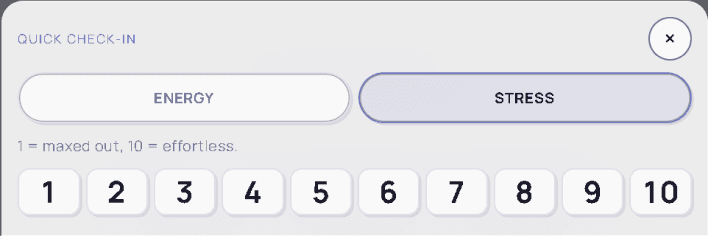
Chronotype calibration and self-reported energy ratings personalize the model. Peripheral signal never interrupts, giving you recovery cues while leaving the choice as yours.

Physical Device
3D-printed battery device with a CrowPanel e-ink display and RGB LED ring. The compact, desk-friendly form uses e-ink for low power, ambient readability, and a non-screen-like feel.
Software Model
Flask backend running an ODE-based energy model. It polls ActivityWatch to update two variables: cognitive energy (E) and stress (S), which evolve based on work and recovery signals.
Ambient Awareness Without Obligation
Users should feel:
Informed: They know their current cognitive state without having to think about it.
Permitted: Seeing a depleted battery legitimizes taking a break, rather than pushing through.
In control: The signal is peripheral; the device does not interrupt, enforce, or prescribe.
Over time, the goal is a shift from reactive recovery (crashing after exhaustion) to proactive self-regulation (adjusting before depletion becomes critical).
Web App
Our app mirrors the device and adds deeper analytics: circadian baseline, activity breakdowns, phase portraits, and self-report tools for users without the hardware (psych-battery.vercel.app)



Possible Applications
Existing sensing technologies require a device such as a sensor or a camera that can detect an object's physical, chemical, or biological parameters and then convert the information into an electrical signal.
However, WiFi-sensing makes use of existing devices and WiFi signals present in the WiFi network, which can be used for applications such as detection (human presence and activity such as falling, walking detection), recognition (activity recognition, gesture recognition, and human/user identification/authentication) and estimation (estimation of breathing rate, heart rate, etc.).
Click here to learn more about what you can do with Home Awareness
Traditional home security systems often rely on visual detection (cameras). An intruder alarm can then be sounded, both within the property and remotely via smartphones etc. WiFi-sensing can provide a superior form of motion detection as it is:
non-line-of-sight technology — it can ‘see’ through walls
privacy-conscious — it protects the privacy of home or building occupants as there is no acquisition or recording of personal data.
Home Security
The population is aging, with the worldwide population of over 60s expected to grow to 1.4 billion by 2030. Most of those 65 and overspend the majority of their time at home. The risk of falling is a serious issue for those over 65, and is a leading cause of death.
Existing technologies for elderly fall detection include ambient sensing, wearables, and vision-based technology.
The problem with ambient vision-based technology is that it is ‘line of sight’: It will generally only work in the room in which the individual is located. By contrast, WiFi-sensing can detect falls, despite the presence of walls. It also doesn’t rely on the acquisition and transmission of personal data as a vision-based system does. So far, wearables have been known to be error-prone with a high number of ‘false positives’.
Fall detection applications will be invaluable both in the home and in assisted living contexts.
More generally, WiFi-sensing can be a useful home monitoring tool for family well-being: It can detect, for example, whether children have arrived in the house, or left, at a scheduled time
Healthcare and Well-Being Monitoring
WiFi-sensing can be used to detect when individuals have arrived home, and when they have left, and power down appliances and devices accordingly.
This could be of interest to property technology (PropTech) firms, and consumer electronics manufacturers as part of establishing energy-efficient homes and buildings. Energy efficiency applications may also be beneficial to EnergyTech firms that create energy rates and tariffs based on consumption.
Consider the case of HVAC systems: As heavy energy users, optimizing the use of these systems could have considerable energy efficiency benefits. An important optimization measure is that their cooling and heating setpoints are increased and decreased during unoccupied times with the goal of saving energy. The best way of achieving this is to have real occupancy data, the kind of data that WiFi sensing is well-positioned to provide. For more information see Kingsley Nweye, Zoltan Nagy. “MARTINI: Smart meter driven estimation of HVAC schedules and energy savings based on Wi-Fi sensing and clustering“. Applied Energy. Volume 316, 2022.
Energy Efficiency
Overview
Possible applications
Benefits
Privacy

Search
Sign In

Deals
Devices
Accessories
Plans
Home Services
Prepaid
Personal
Business
More
Support
Find a Store
Español


Future Development Priorities
Key challenges included balancing speculative ideas with real workplace constraints, translating behavioral insights into concrete designs, and avoiding over-reliance on AI-generated outputs, which often reduced emotional and contextual nuance. We addressed risks by triangulating human observation with AI synthesis, validating outputs manually, and prioritizing grounded insights over purely generative ideas.
Looking ahead, future development would focus on real-world prototyping and testing, richer observational datasets, and more iterative design refinement. AI would be used more for simulation and pattern detection, while humans would retain primary responsibility for interpretation, emotional judgment, and final concept decisions.
Final Solution

Core Vision & Tensions
Our project envisions a physical-digital work environment that supports sustained focus, healthy communication boundaries, and human connection in AI-augmented workplaces. The goal is to reduce burnout by shifting attention management from an individual burden to a system-supported experience.
A central tension emerged between playfulness and literalness in the battery metaphor. Inspired by pixel art from vintage video games, we envisioned the battery as akin to a life bar. However, we didn’t adopt a gamified aesthetic because we did not want user behavior to be guided by metrics or reduced to "winning" at energy management.
The Team

Elisa Lupin-Jimenez
Master of Design

BA in Cognitive Science
Madison Lee

Douglas McGowan
PhD in Mechanical Engineering

Apolline Tardy
PhD in Information Sciences